UPSC CSE Prelims 2021
Consider two Statements and four Conclusions given below. You have to take the Statements to be true even if they seem to be at variance from the commonly known facts. Read all conclusions and then decide which of the given Conclusion(s) logically follows/follow from the Statements, disregarding the commonly known facts.
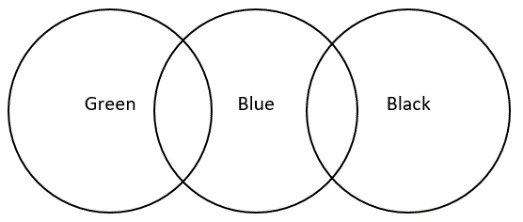
- Statement-1: Some greens are blues.
- Statements-2: Some blues are blacks.
- Conclusion-1: Some greens are blacks.
- Conclusion-2: No green is black.
- Conclusion-3: All greens are blacks.
- Conclusion-4: All blacks are greens.
EXPLANATION
Correct Option
Neither Conclusion 1 nor 2 nor 3 nor 4
The given statements are:
- Statement-1: Some greens are blues.
- Statement-2: Some blues are blacks.
Both statements are 'I' type propositions (Particular Affirmative). In the rules of syllogism, no definite conclusion can be drawn from two particular affirmative statements (I + I type). This means that based solely on these statements, a necessary relationship between 'greens' and 'blacks' cannot be established.
Let us analyze each conclusion:
- Conclusion-1: Some greens are blacks.
- Conclusion-2: No green is black.
- Conclusion-3: All greens are blacks.
- Conclusion-4: All blacks are greens.
From the statements, it is possible for some greens to be blacks, and it is also possible for no greens to be blacks. For instance, the set of 'greens' might entirely overlap with the set of 'blacks' through the 'blues', or they might remain distinct. Since neither scenario is necessarily true under all possible interpretations of the statements, no definitive conclusion can be drawn.
Conclusions 1 and 2 are contradictory pairs, and since neither can be definitively proven true or false, they do not logically follow. Conclusions 3 and 4 are universal statements, which are even stronger claims than particular ones, and thus cannot be derived from two particular premises.
Therefore, none of the given conclusions logically follow from the statements.
Incorrect Options
Options 1, 2, and 3 are incorrect because they assert that one or more specific conclusions logically follow from the given statements. As established by the rules of syllogism, two particular affirmative statements (I + I type) do not yield a definite conclusion. Consequently, none of the individual conclusions (1, 2, 3, or 4) can be necessarily inferred as true based on the premises provided.