Q 16 / 45
UPSC CSE Prelims 2019
In a group of 15 people; 7 can read French, 8 can read English while 3 of them can read neither of these two languages. The number of people who can read exactly one language is
EXPLANATION
Correct Option (B)
To determine the number of people who can read exactly one language, the following steps are undertaken:
- Total number of individuals in the group = 15.
- Number of individuals who read neither French nor English = 3.
- The number of individuals who read at least one language is calculated as: Total individuals - Individuals reading neither = 15 - 3 = 12.
- Let F denote the set of individuals who read French, and E denote the set of individuals who read English.
- Given: |F| = 7 and |E| = 8.
- Applying the Principle of Inclusion-Exclusion for two sets: |F ∪ E| = |F| + |E| - |F ∩ E|.
- Substituting the known values: 12 = 7 + 8 - |F ∩ E|.
- This simplifies to: 12 = 15 - |F ∩ E|.
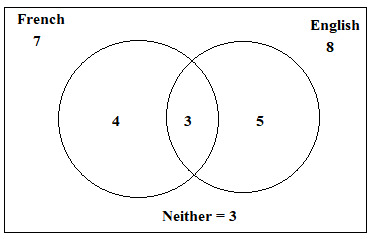
- Therefore, the number of individuals who read both languages, |F ∩ E|, is 15 - 12 = 3.
- The number of individuals who read only French = |F| - |F ∩ E| = 7 - 3 = 4.
- The number of individuals who read only English = |E| - |F ∩ E| = 8 - 3 = 5.
- The number of individuals who can read exactly one language is the sum of those who read only French and those who read only English: 4 + 5 = 9.
Incorrect Options:
- Option 1 (10): This value does not correspond to any specific calculated subset based on the problem's conditions.
- Option 3 (5): This represents the number of individuals who can read only English.
- Option 4 (4): This represents the number of individuals who can read only French.