UPSC CSE Prelims 2014
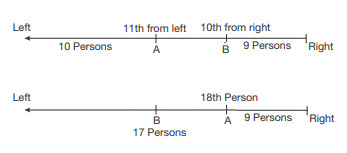
In a row ‘A’ is in the 11th position from the left and ‘B’ is the 10th position from the right. If ‘A’ and ‘B’ interchange, then ‘A’ becomes 18th from the left. How many persons are there is the row other than ‘A’ and ‘B’?
EXPLANATION
Correct Option
The problem involves calculating the total number of persons in a row and then determining the count excluding two specific individuals. Initially, A is 11th from the left, and B is 10th from the right. Upon interchanging positions, A occupies B's original position, and this new position for A is 18th from the left. This implies that the position B originally held is 18th from the left and also 10th from the right.
The total number of persons in a row can be calculated using the formula: Total Persons = (Position from Left) + (Position from Right) - 1. Applying this to the position B originally occupied (which A now holds):
- Total Persons = 18 (A's new position from left) + 10 (B's original position from right) - 1
- Total Persons = 28 - 1 = 27
The question asks for the number of persons in the row *other than* A and B. Therefore, subtract A and B from the total count:
- Persons other than A and B = Total Persons - 2
- Persons other than A and B = 27 - 2 = 25
Incorrect Options
Options 1 (27), 2 (26), and 4 (24) are incorrect.
- Option 1 (27) represents the total number of persons in the row, not the number of persons excluding A and B. The question specifically asks for the count *other than* A and B.
- Options 2 (26) and 4 (24) result from miscalculations of the total number of persons or an incorrect subtraction for the final answer. The derived total of 27 persons, and subsequent subtraction of 2, leads definitively to 25.