UPSC CSE Prelims 2013
Five people A, B, C, D and E are seated about a round table. Every chair is spaced equidistant from adjacent chairs.
- C is seated next to A
- A is seated 2 seats from D
- B is not seated next to A
Which of the following must be true?
- D is seated next to B
- E is seated next to A
Select the correct answer from the codes given below:
EXPLANATION
Correct Option (3)
The problem requires determining which statements must be true based on the seating arrangement of five people (A, B, C, D, E) around a circular table, given the following conditions:
- C is seated next to A.
- A is seated 2 seats from D.
- B is not seated next to A.
To identify the definitive arrangement, we systematically apply these conditions:
Step 1: Establish initial placements based on Conditions 1 and 2.
Given a circular table with five seats, if A is at a specific position, Condition 2 implies D's position is fixed relative to A (e.g., if A is at seat 1, D is at seat 4). Condition 1 implies C is adjacent to A. This leads to two fundamental configurations for A, C, and D:
-
Configuration 1: A-C-X-D-Y (C is clockwise to A)
- If A is placed, C must be in an adjacent seat. Let's assume C is immediately clockwise to A.
- A is 2 seats from D. This fixes D's position.
- The partial arrangement is A C _ D _ (where _ represents empty seats).
-
Configuration 2: C-A-X-Y-D (C is anti-clockwise to A)
- Alternatively, C could be immediately anti-clockwise to A.
- A is 2 seats from D. This fixes D's position.
- The partial arrangement is C A _ _ D.
Step 2: Incorporate Condition 3 (B is not seated next to A) to derive valid arrangements.
The remaining two people (B and E) must fill the empty seats in each configuration. We then check Condition 3.
-
From Configuration 1 (A C _ D _):
- Possibility 1.1: A C B D E (B fills the seat between C and D, E fills the seat between D and A).
- Check Condition 3: A is adjacent to C and E. B is not adjacent to A. This arrangement is valid.
- Possibility 1.2: A C E D B (E fills the seat between C and D, B fills the seat between D and A).
- Check Condition 3: A is adjacent to C and B. This violates Condition 3 (B is next to A). This arrangement is invalid.
- Possibility 1.1: A C B D E (B fills the seat between C and D, E fills the seat between D and A).
-
From Configuration 2 (C A _ _ D):
- Possibility 2.1: C A B E D (B fills the seat between A and E, E fills the seat between B and D).
- Check Condition 3: A is adjacent to C and B. This violates Condition 3 (B is next to A). This arrangement is invalid.
- Possibility 2.2: C A E B D (E fills the seat between A and B, B fills the seat between E and D).
- Check Condition 3: A is adjacent to C and E. B is not adjacent to A. This arrangement is valid.
- Possibility 2.1: C A B E D (B fills the seat between A and E, E fills the seat between B and D).
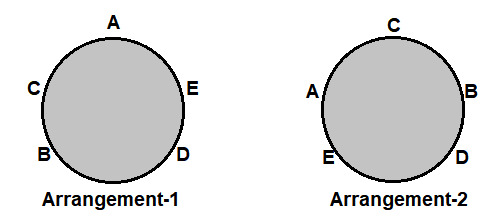
Thus, there are two unique valid seating arrangements (considering rotations as equivalent):
- Arrangement 1: A - C - B - D - E (clockwise sequence)
- Arrangement 2: C - A - E - B - D (clockwise sequence)
Step 3: Evaluate the given statements against all valid arrangements.
-
Statement I: D is seated next to B.
- In Arrangement 1 (A-C-B-D-E), B and D are adjacent.
- In Arrangement 2 (C-A-E-B-D), B and D are adjacent.
- Therefore, Statement I is true in all valid arrangements.
-
Statement II: E is seated next to A.
- In Arrangement 1 (A-C-B-D-E), E and A are adjacent.
- In Arrangement 2 (C-A-E-B-D), E and A are adjacent.
- Therefore, Statement II is true in all valid arrangements.
Since both Statement I and Statement II are true for every possible valid seating arrangement, they must both be true.
Incorrect Options:
Options 1, 2, and 4 are incorrect because the comprehensive analysis of all valid seating arrangements demonstrates that both Statement I ("D is seated next to B") and Statement II ("E is seated next to A") are consistently true. Therefore, selecting only one of these statements or asserting that neither is true would contradict the derived seating possibilities.